Research concentration reference
Check the vial. See the concentration.
Choose a RetaGrade catalog vial to see its 2 mL BAC-water reference and nominal concentration. The page also separates that arithmetic from published clinical-trial evidence.
Guided calculator
Choose a vial. See the suggested BAC water and concentration.
Step 1 · Vial
Which vial are you checking?
Choose the amount printed on the vial label.
Step 2 · RetaGrade reference
See the suggested BAC-water volume.
This catalog-vial reference uses 2 mL for 10, 15, and 20 mg research vials.
Vial selected
10 mg
Suggested BAC water
2 mL
RetaGrade research/reference suggestion
Capacity check: this reference assumes the vial is rated to accommodate the full 2 mL with usable headspace. Do not force liquid into an undersized container.
How are the reference concentrations calculated?+
The calculator divides 10, 15, or 20 mg by the suggested 2 mL BAC-water volume, producing 5, 7.5, or 10 mg/mL. Confirm that the vial is rated for the full volume with usable headspace; never force liquid into an undersized container.
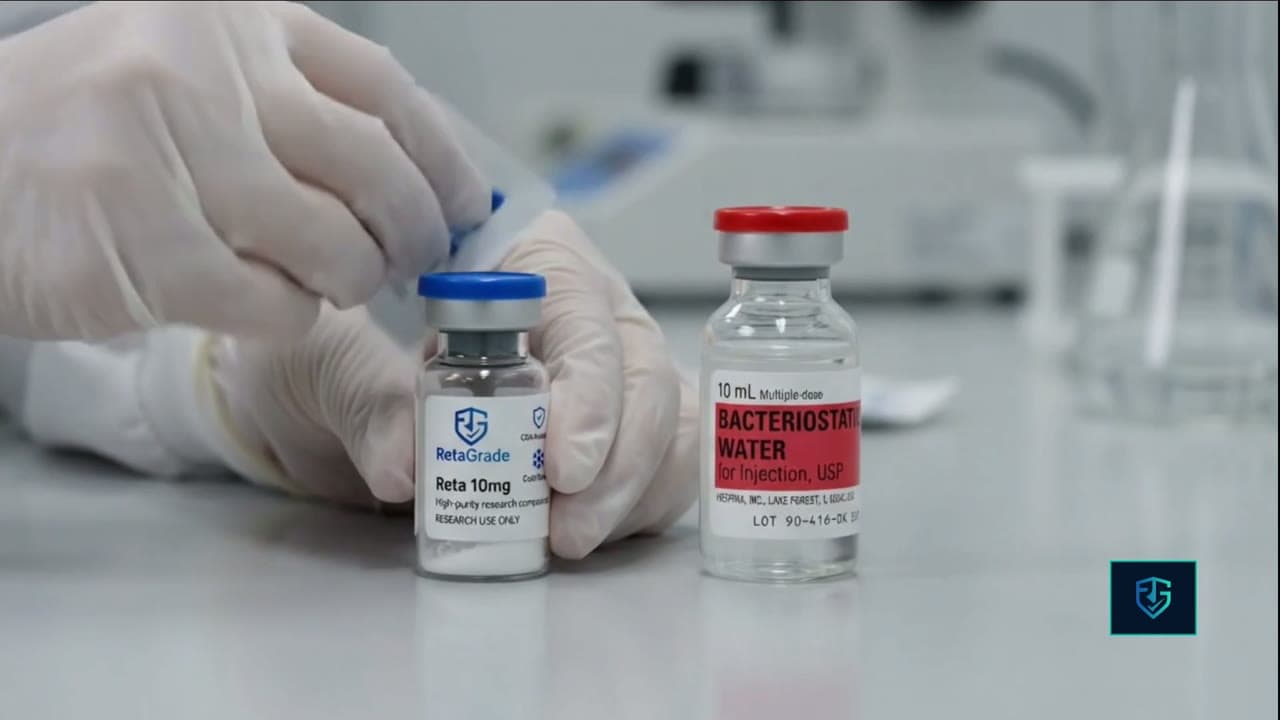 9 steps · 27 seconds
 RetaGradeRetaGrade Video GuideWatch step by step2 parts
RetaGrade Video Guide
Watch the process one step at a time.
Nine short videos cover vial preparation and the final demonstration. Select any step to watch it and read a clear description.
Part 1 · Steps 1–6
Vial preparation
Vial-top wipe, BAC-water reference, transfer, gentle swirls, and drawing from the vial.
Part 2 · Steps 7–9
Recorded demonstration
Clearly labeled demonstration videos with the research-use boundary kept visible.
Research Comparison Portal
Clinical Cohort Matcher & Simulator
Compare a baseline profile with historical subjects from published phase 2 obesity, type 2 diabetes, and MASLD research and with the editorial case review. This is an educational comparison, not an individual forecast.
Subject measurements
Enter a hypothetical research profile to query the historical comparison set.
Comparison with the self-tracked journey
The individual self-tracked case review began from a stated 275.4 lb baseline. Its observations are Tier D evidence and should not be treated as a clinical prediction.
RetaGradeEvidence-system integration
Eli Lilly NEJM
NEJMoa2301972
Tier A (RCT) / Tier D
System ready
Methodology note: Baseline values are compared with reconstructed published endpoints. The result is not a substitute for professional medical guidance and does not predict an individual's outcome.
Published mean endpoint
−20.0%
Illustrative 27-week comparisonArithmetic illustration
168.0lbs
Illustrative weight using the published meanHistorical study schedule
A simplified display of phase 2 escalation schedules for context only.
Weeks 1–4 · 0.5 mg/week
Starting phase
Weeks 5–8 · 2 mg/week
Increase by 1.5 mg
Weeks 9–12 · 4 mg/week
Increase by 2 mg
Week 13+ · 6 mg/week
Maintenance phase
Research checkpoint
The comparison window is 27 weeks; individual timing cannot be inferred from the mean.
Protocol observations
Published studies used scheduled visits throughout the trial, including assessments at predefined study weeks.
Published cohort context
- Gastrointestinal adverse events were among the most commonly reported events.
- Lower starting schedules were associated with better tolerability in the study.
- Study-arm completion: approximately 88%.
Research administration facts
Keep trial facts separate from catalog-vial arithmetic.
The published studies describe sponsor-supplied trial material and controlled research protocols. They do not establish a personal administration plan or validate the site's 2 mL catalog-vial reference.

Evidence context
Published methods answer population-level questions.
Routes, study arms, measurements, and outcomes come from defined protocols—not from a personal calculator.
Published route
Subcutaneous administration in trials
Published clinical trials describe subcutaneous administration by trained study teams under protocol controls.
Study arms
Fixed protocol-defined groups
Trial doses and escalation schedules were assigned by study protocol, not selected from this page.
Body size
Not a validated dose calculator
Weight, height, or BMI do not create a validated individual retatrutide dose equation.
Not established
No approved personal-use instructions
Retatrutide remains investigational; this page does not provide personal dosing or administration guidance.
What the phase 2 protocol actually says
The study used an already-prepared 12 mg / 2 mL solution.
The protocol describes sponsor-supplied trial product at 6 mg/mL. That is a trial-product fact—not a reconstitution instruction for RetaGrade catalog vials.
12 mg
Study-product amount
2 mL
Study-product volume
6 mg/mL
Study concentration
Review the protocol record and supporting source documents for the full research context.
Published phase 2 context
Trials report group outcomes at defined checkpoints.
These figures describe randomized groups under a study protocol. They are not a forecast for one person.
Population
338
randomized participants
Adults with obesity or overweight and a weight-related condition were enrolled under defined criteria.
Week 24
−7.2% to −17.9%
mean weight change range
Reported means varied by study arm at the prespecified intermediate checkpoint.
Week 48
−8.7% to −24.2%
mean weight change range
Group means at the final checkpoint do not determine an individual's result or timing.
What trials can show
Average differences between assigned groups
Randomization and prespecified analyses support group-level estimates with stated uncertainty.
What they cannot show
A personal result or timetable
Population averages cannot calculate whether or when one person will reach a goal weight.
Primary source: New England Journal of Medicine, phase 2 obesity trial.
Research-reference questions
Clear answers about what the calculator does—and does not—establish.
Can published research calculate how long it will take to reach a goal weight?
No. Trials report population averages at fixed checkpoints. They do not provide a validated equation that predicts whether or when one person will reach a particular goal weight.
What BAC-water volume does the calculator suggest?
The RetaGrade reference is 2 mL for its 10, 15, and 20 mg catalog vials, producing nominal concentrations of 5, 7.5, and 10 mg/mL. This is a RetaGrade suggestion, not an NEJM-derived rule.
Does the NEJM protocol validate the RetaGrade 2 mL suggestion?
No. The protocol describes an already-prepared, sponsor-supplied 12 mg / 2 mL study solution at 6 mg/mL. It does not validate catalog-vial reconstitution.
What if the vial cannot accommodate 2 mL?
Do not force liquid into an undersized vial. Confirm the actual vial is rated for the full volume with usable headspace.
Does the calculator replace lot verification?
No. Use the batch lookup to verify the lot certificate separately. Concentration arithmetic does not establish identity, purity, sterility, or suitability.
Does this page provide administration or dosing guidance?
No. It does not select a personal dose, convert syringe units, recommend a needle or site, or authorize human use.
Clinical evidence
Review the published research.
Explore the source-attributed trial dashboard, mechanisms, outcomes, and limitations.
Open evidence reviewBatch verification
Check the certificate tied to a lot.
Use the lookup code from a vial label to open its published certificate.
Verify a batch