
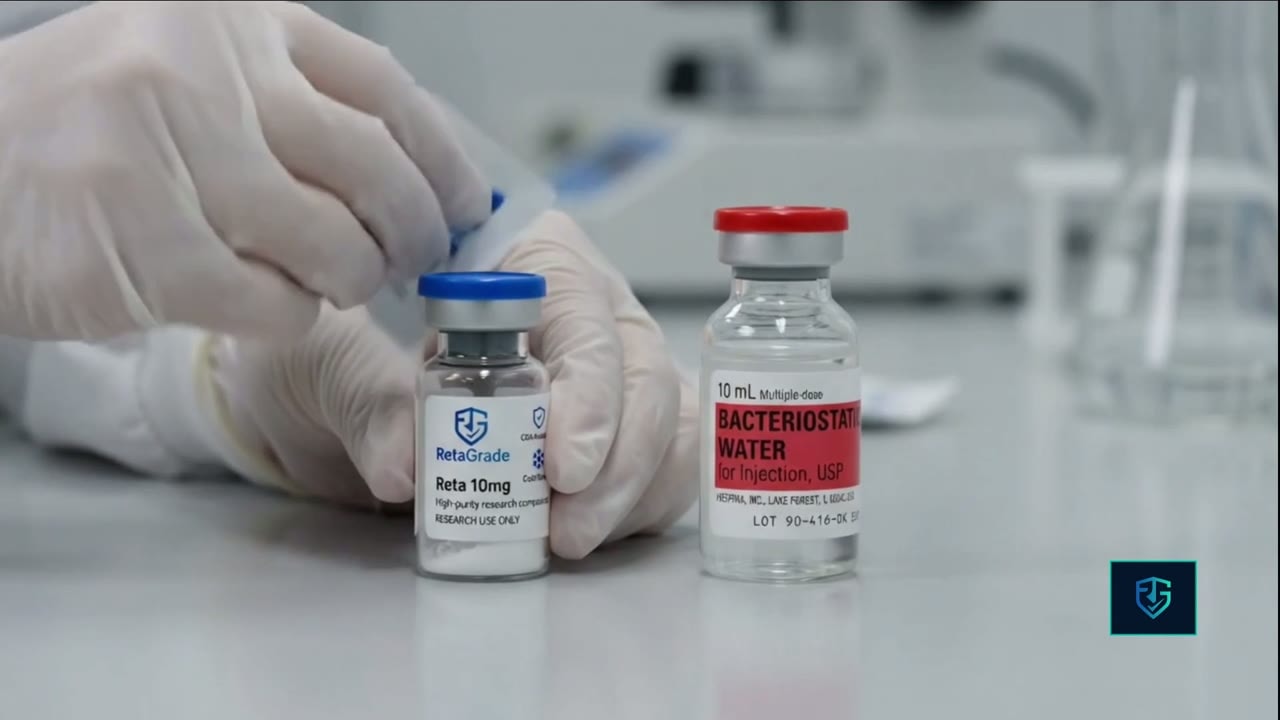
Retatrutide reconstitution,one step at a time.
Nine short videos walk through reconstituting a retatrutide research vial with bacteriostatic water. Choose any step below or watch both parts in order.
9
short videos
2
parts
27 sec
total watch
Step-by-step reconstitution guide
Nine videos in two parts.
Choose any step to watch its clip and read a short description.
Part 1 · Vial preparation · Step 01
~0:03Wiping the vial tops
A clean alcohol pad is used to wipe both rubber stoppers before either vial is accessed.
Important reference: Allow both stoppers to dry fully. If a cleaned top is touched, clean it again before access.
Choose a step
Open any clip in the two-part sequence.
Reconstitution, defined
What retatrutide reconstitution actually means
Reconstitution is the laboratory step that returns a dry, freeze-dried solid to a liquid. RetaGrade ships retatrutide as a lyophilized cake sealed in a glass vial, because the peptide is far more stable dry than wet: with the water removed there is almost nothing for hydrolysis, oxidation, or microbial growth to act on. That same stability is why nothing can be measured, transferred, or characterized until the material is back in solution. A powder has a mass but no concentration, and concentration is the only quantity the rest of a bench workflow can actually use.
Reconstituting retatrutide therefore means adding a known volume of a suitable diluent — bacteriostatic water throughout this guide — to a vial holding a known labeled mass, then letting the solid dissolve without agitation harsh enough to damage it. Nothing is being created, strengthened, or weakened in any pharmacological sense. You are converting a labeled mass into a defined mg/mL figure, and every number downstream inherits the accuracy of the volume you measured.
The nine clips on this page show that sequence performed once, end to end, on a RetaGrade catalog vial. The written guide below covers the same ground in text — what each step accomplishes, why the order matters, and what to look at while it happens — because a 27-second reel is a demonstration, not a reference. Everything here is written for authorized laboratory handling. RetaGrade retatrutide is sold for research use only and is not for human use.
- Lyophilized cake
- The white disc or loose powder at the bottom of a sealed vial. Freeze-drying pulls water off under vacuum, leaving the peptide in a dry solid that tolerates shipping and long storage far better than any solution would.
- Diluent
- The liquid added to dissolve the solid. This guide uses bacteriostatic water, a sterile water preserved with 0.9% benzyl alcohol so a vial can be entered more than once.
- Nominal concentration
- Labeled mass divided by added volume, in mg/mL. It is called nominal because it assumes the vial holds exactly its labeled mass and that exactly the intended volume went in.
The arithmetic
Reconstitution math is one division
Take the milligram figure printed on the vial label, divide it by the millilitres of bacteriostatic water added, and the result is the concentration of the finished solution in milligrams per millilitre. Nothing else in the calculation moves. The mass inside the vial was fixed at the moment it was filled, so volume is the only variable in your hands.
Add less water and you get a smaller volume of a more concentrated solution; add more and you get a larger volume of a weaker one. The total milligrams in the vial is identical either way. This is the most common point of confusion in the whole procedure — a more concentrated reconstitution has not added anything, it has only spread the same mass through less liquid.
The formula
vial strength (mg) ÷ bacteriostatic water added (mL) = concentration (mg/mL)
Worked below for every RetaGrade catalog strength at the 2 mL reference this guide uses.
Concentration at the 2 mL RetaGrade reference
Each catalog strength reconstituted with 2 mL of bacteriostatic water.
| Vial strength | BAC water added | Arithmetic | Nominal concentration |
|---|---|---|---|
| 10 mg | 2 mL | 10 ÷ 2 | 5 mg/mL |
| 15 mg | 2 mL | 15 ÷ 2 | 7.5 mg/mL |
| 20 mg | 2 mL | 20 ÷ 2 | 10 mg/mL |
The same 10 mg vial at other volumes
Shown only to make the inverse relationship concrete.
| BAC water added | Arithmetic | Nominal concentration |
|---|---|---|
| 1 mL | 10 ÷ 1 | 10 mg/mL |
| 1.5 mL | 10 ÷ 1.5 | 6.67 mg/mL |
| 2 mL | 10 ÷ 2 | 5 mg/mL |
| 2.5 mL | 10 ÷ 2.5 | 4 mg/mL |
| 3 mL | 10 ÷ 3 | 3.33 mg/mL |
Two millilitres is the reference this guide uses. Any other volume still has to fit the vial with usable headspace left over, and values shown are rounded to two decimals.
Concentration is where this page stops. RetaGrade publishes mg/mL and nothing beyond it. There is no conversion from milligrams to syringe units anywhere on this site, no volume to withdraw, and no schedule. Those are decisions for a qualified researcher working under their own protocol, and no figure on this page substitutes for one.
Materials and technique
What sits on the bench, and why each item is there
Reconstitution needs very little equipment, but each item is doing one specific job and substituting it changes the outcome.
Bacteriostatic water
Sterile water containing 0.9% benzyl alcohol. That preservative is the entire reason it exists as a separate product: it suppresses microbial growth, so a vial can be entered with a fresh needle more than once over a period of days without the solution turning into a growth medium. Unpreserved sterile water offers no such protection after the first entry, and 0.9% sodium chloride is likewise unpreserved while also shifting the pH of the finished solution.
The retatrutide vial
Read the label and the lot code before anything else, then confirm the vial's physical capacity. A vial cannot usefully take a volume that leaves no headspace — forcing liquid into an undersized vial pressurizes it and pushes solution back up the needle and out around the stopper. Capacity is a hard constraint, not a preference.
Alcohol pads
70% isopropyl, a fresh pad per stopper. Wipe in one direction and then leave the surface to air-dry: the drying is the disinfection, not the wiping. A stopper still visibly wet carries alcohol into the vial on the needle.
A syringe sized for the transfer
A larger-barrel syringe measures 2 mL far more accurately than a small one working at the very top of its range, and that single measurement fixes the concentration for the life of the vial. Use a fresh needle for every entry.
A clean, still work surface
Wipe the bench, keep it uncluttered, keep stoppers facing up, and never set an uncapped needle down. Aseptic technique at this level is mostly a discipline of not touching things — the stopper face, the needle shaft, and the syringe tip should contact nothing but each other.
Step by step, in writing
What is happening in each clip
Every clip above runs a few seconds. Here is the same sequence written out — what the step accomplishes, and what to watch while it happens. Numbering and order match the player.
- 01
Wiping the vial tops
Both stoppers — the retatrutide vial and the bacteriostatic water vial — are wiped with a fresh alcohol pad before a needle touches either one. The rubber closure is the only barrier between a sealed interior and the room, and a needle passing through it carries whatever is sitting on that surface inside with it. Wipe in one direction, use a separate pad per stopper, then leave both to air-dry for several seconds. The drying is what does the work; a stopper still wet with isopropyl simply passes alcohol into the vial on the needle. If a cleaned stopper is touched, brushed against a sleeve, or set face-down, clean it again.
- 02
Drawing the BAC water
Bacteriostatic water is drawn into the larger syringe until the plunger seal sits on the 2 mL mark. This is the measurement that determines the concentration of everything that follows, so it is the step worth slowing down for. Read the graduation at eye level, take the volume from the leading edge of the plunger's rubber seal rather than its domed centre, and clear any air bubble clinging inside the barrel before you read — an air gap the size of a grain of rice is a real fraction of 2 mL. Drawing slightly past the mark and easing back is more accurate than creeping up to it. Confirm before this step that the retatrutide vial can hold the full volume with space to spare.
- 03
Adding BAC water to the vial
With the needle through the stopper, the syringe is angled so the water runs down the inside glass wall instead of jetting straight onto the lyophilized cake. Peptides are surface-active and mechanically fragile; a fast stream landing directly on the powder drives material into the air-liquid interface, which is exactly where unfolding and foaming begin. Let the 2 mL go in slowly. Some vials are sealed under partial vacuum and will draw the liquid in on their own — allow it, but keep the plunger under control rather than letting the vacuum pull the barrel down. The 2 mL figure is RetaGrade's catalog-vial reference for the 10, 15, and 20 mg strengths, not a rule carried over from any clinical protocol.
- 04
First gentle swirl
The vial stays upright and moves in slow circles, on the bench or between the fingers. This is the dissolution step and it rewards patience rather than force. Retatrutide will usually go into solution on its own within a minute or two of contact with the diluent; the swirl exists only to keep fresh liquid moving across the surface of the cake. Never shake, snap, or vortex the vial. Shaking whips air into the solution and creates a large air-liquid interface, and it is that interface — not the motion itself — that unfolds peptide chains and produces persistent foam you then have to wait out before anything can be inspected.
- 05
Final gentle swirl
After a short rest the vial gets one more gentle swirl and then an inspection. What you want to see is a clear, colorless, particle-free solution: no cake left at the bottom, no flakes drifting when the vial is tilted against a light background, no haze. Hold it still and look through it rather than at it. This check confirms dissolution and nothing else — clarity cannot tell you whether the contents are sterile, correctly identified, present at the labeled mass, or suitable for any particular purpose. Those questions are answered by the lot label and the certificate of analysis, which are separate documents and should be checked separately.
- 06
Drawing from the vial
To take liquid out of a sealed vial you first have to put something in, or the vial drops to negative pressure and fights the plunger the whole way. The clip shows the standard approach: push a matching volume of air into the headspace above the liquid, invert the vial, then withdraw with the needle tip below the liquid line so the barrel fills with solution instead of air. Keeping that tip submerged is the entire trick — a tip that breaks the surface pulls a bubble that has to be cleared and re-drawn. The syringe graduations visible in the recording are incidental to the video. They are not a recommended amount, not a dose, and not a conversion between milligrams and syringe units.
Steps 07 to 09 are deliberately not written out The final three clips are a recorded demonstration, and this written guide stops before them on purpose. RetaGrade retatrutide is sold for laboratory research use only, so there is no written procedure here for area preparation, administration, or aftercare, and nothing in those clips should be read as instruction, as a recommended technique or site, or as authorization for human use. The written guide ends at the vial.
About the 2 mL reference
The 2 mL amount is the RetaGrade reference used in this guide.
It applies to the 10, 15, and 20 mg retatrutide catalog vials shown here and should not be presented as a clinical-trial rule.
Confirm vial capacity: The vial must hold the full 2 mL with usable space remaining. Never force liquid into a vial that is too small.
Important information
This video guide is for research reference only.
It does not choose a dose, convert milligrams to syringe units, recommend a needle or application site, or provide a personal administration plan. Syringe markings are examples from the recording. The final three videos are a recorded demonstration only. RetaGrade products are for research use only and are not for human use.
Storage and stability
Before and after reconstitution are two different materials
A sealed lyophilized vial and a reconstituted one behave nothing alike, and the difference is water. Dry, the peptide has very little chemical freedom: hydrolysis, deamidation, and oxidation all need a solvent to proceed in, and microbial growth needs one too. That is why the freeze-dried form survives shipping and long refrigerated storage. The moment the bacteriostatic water goes in, every one of those pathways opens at once — which is why reconstituted material has a materially shorter usable window than the vial it came from.
Sealed and lyophilized
Keep unopened vials refrigerated at 2–8 °C, sealed, and out of light — photodegradation is not a theoretical concern for peptides, so store vials in their carton or a closed box rather than on an open shelf. Let a cold vial come up to room temperature before you open it. Condensation forming on cold glass in a warm room is water arriving somewhere you did not intend.
In solution
Refrigerate reconstituted vials at 2–8 °C, upright, dark, and never frozen. Ice formation concentrates solutes and drags peptide to the freezing interface, and repeated freeze-thaw cycles are one of the more reliable ways to lose material. The benzyl alcohol in bacteriostatic water is a bacteriostat, not a sterilant and not a stabilizer: it slows microbial growth in a multiply-entered vial and does nothing whatsoever about chemical degradation of the peptide.
Label it at the bench
Write the reconstitution date and the concentration you calculated onto the vial in the moment, not later. An unlabeled vial in a shared refrigerator is an unknown within a week. Keep it out of the door, where the temperature cycles most, and use a fresh needle for every entry.
Why no expiry figure is published for reconstituted material
RetaGrade does not publish a usable-window figure for a reconstituted vial. Stability in solution depends on the diluent, the storage temperature, the number of entries, and the specific lot, and a single number printed on a web page would be a guess presented as a specification. The storage conditions above are published because they are known. A shelf-life number for solution is not, so none is given.
Troubleshooting
Reading what the vial is telling you
A reconstituted vial gives you a small amount of visual information, and most of it is unambiguous once you know what causes what.
The solution is cloudy or hazy
A haze that does not clear on standing is not normal — a correctly reconstituted peptide solution should be clear and colorless. Cloudiness usually indicates aggregation, meaning chains have come out of solution and associated with one another, and the common causes are mechanical: shaking, a diluent stream fired straight onto the cake, or a large temperature swing. Contamination is the other possibility. Do not assume cloudy material is usable; document what you see, set the vial aside, and take it up against the lot documentation and the certificate of analysis.
Powder is still sitting at the bottom
Undissolved cake after a couple of gentle swirls usually just means it needs more time. Let the vial stand at room temperature for five to ten minutes and swirl again — dissolution is slower than most people expect, especially for a vial taken straight from the refrigerator. What it does not mean is that the vial needs shaking. If solid material is still visible after fifteen to twenty minutes of gentle handling at room temperature, stop and treat that as a question about the vial rather than a technique problem to force through.
The vial is full of foam
Foam is the signature of shaking. It is air whipped into the solution, and it matters twice over: the air-liquid interface it creates is where peptide unfolds, and until it collapses you cannot see through the vial to inspect anything at all. Foam from a genuinely gentle swirl is minimal and settles within a minute or two. Foam that fills the headspace and persists means the vial was agitated far harder than it should have been. Let it stand rather than working through it — drawing through foam pulls air instead of liquid.
Fine bubbles clinging to the glass
Small bubbles on the inside wall right after the transfer are dissolved gas coming out of solution, not damage, and they clear on standing. They are not the same phenomenon as foam and are not a reason for concern.
The solution has a tint
Reconstituted retatrutide should be colorless. Any yellow or brown cast is a reason to stop and check the lot documentation rather than continue, and it is worth photographing before the vial is set aside.
The plunger fights back, or liquid weeps around the needle
Both are pressure problems rather than peptide problems. A plunger that pulls back against you means the vial is at negative pressure because not enough air was pushed into the headspace first. Liquid weeping back around the needle at the stopper means the opposite — too much air went in, or the vial was already too full for the volume added. Equalize pressure before drawing, and check the vial's capacity before you commit a volume to it.
Common questions
Retatrutide reconstitution FAQ
The questions researchers actually ask about bringing a lyophilized vial into solution.
How much bacteriostatic water should I add to a retatrutide vial?
There is no single correct volume, because the amount of water you add sets the concentration rather than the total milligrams in the vial. RetaGrade's catalog reference for the 10, 15, and 20 mg research vials is 2 mL of bacteriostatic water, which gives 5, 7.5, and 10 mg/mL respectively. That is a RetaGrade reference figure for laboratory handling, not a rule carried over from a clinical protocol, and whatever volume is chosen must fit the vial with usable headspace remaining.
What concentration does 2 mL give a 10 mg vial?
5 mg/mL. The arithmetic is the labeled mass divided by the volume added: 10 mg ÷ 2 mL = 5 mg/mL. The same 2 mL in a 15 mg vial gives 7.5 mg/mL, and in a 20 mg vial gives 10 mg/mL.
What is bacteriostatic water, and can I use plain sterile water instead?
Bacteriostatic water is sterile water containing 0.9% benzyl alcohol, a preservative that suppresses microbial growth so a vial can be entered more than once over a period of days. Unpreserved sterile water contains no such preservative and offers no protection after the first entry, and 0.9% sodium chloride is also unpreserved while additionally shifting the pH of the finished solution. That is why bacteriostatic water is the diluent used throughout this guide.
How long does reconstituted retatrutide last in the refrigerator?
RetaGrade does not publish a usable-window figure for reconstituted material, because stability in solution depends on the diluent, the storage temperature, how many times the vial has been entered, and the specific lot — a single number would be a guess presented as a specification. What is published is the storage condition: reconstituted vials refrigerated at 2–8 °C, kept upright, kept dark, and never frozen. Reconstituted material has a materially shorter usable window than the sealed lyophilized vial.
Why should you never shake a peptide vial?
Shaking whips air into the solution and creates a large air-liquid interface. Peptides are surface-active, so chains migrate to that interface and unfold there, which is what produces aggregation and haze. The resulting foam also has to settle before the vial can be inspected at all. Slow, gentle swirling moves fresh liquid across the cake without generating that interface, which is why every clip on this page swirls rather than shakes.
Why is my reconstituted vial cloudy?
A haze that does not clear on standing generally indicates aggregation — peptide that has come out of solution — most often caused by shaking, by firing the diluent directly onto the lyophilized cake, or by a sharp temperature swing. Contamination is the other possibility. A correctly reconstituted vial should be clear and colorless, so cloudy material should not be assumed usable and is worth raising against the lot documentation.
Do you have to reconstitute the whole vial at once?
Yes. The lyophilized cake is a single sealed unit and there is no practical way to divide a dry powder accurately inside a closed vial, so the entire contents go into solution in one step and the calculated concentration applies to all of it. This is also why the volume measured before the transfer matters so much — it is measured once and it fixes the mg/mL figure for the life of the vial.
Does this guide tell me how many units to draw?
No. RetaGrade publishes concentration in mg/mL and stops there. This page does not convert milligrams into syringe units, does not select an amount to withdraw, and does not provide an administration plan of any kind. Those are decisions for a qualified researcher working under their own protocol. RetaGrade products are sold for laboratory research use only and are not for human use.
Continue exploring
Calculate a retatrutide vial's concentration.
Use the retatrutide reconstitution calculator for nominal concentration arithmetic and its source boundary.