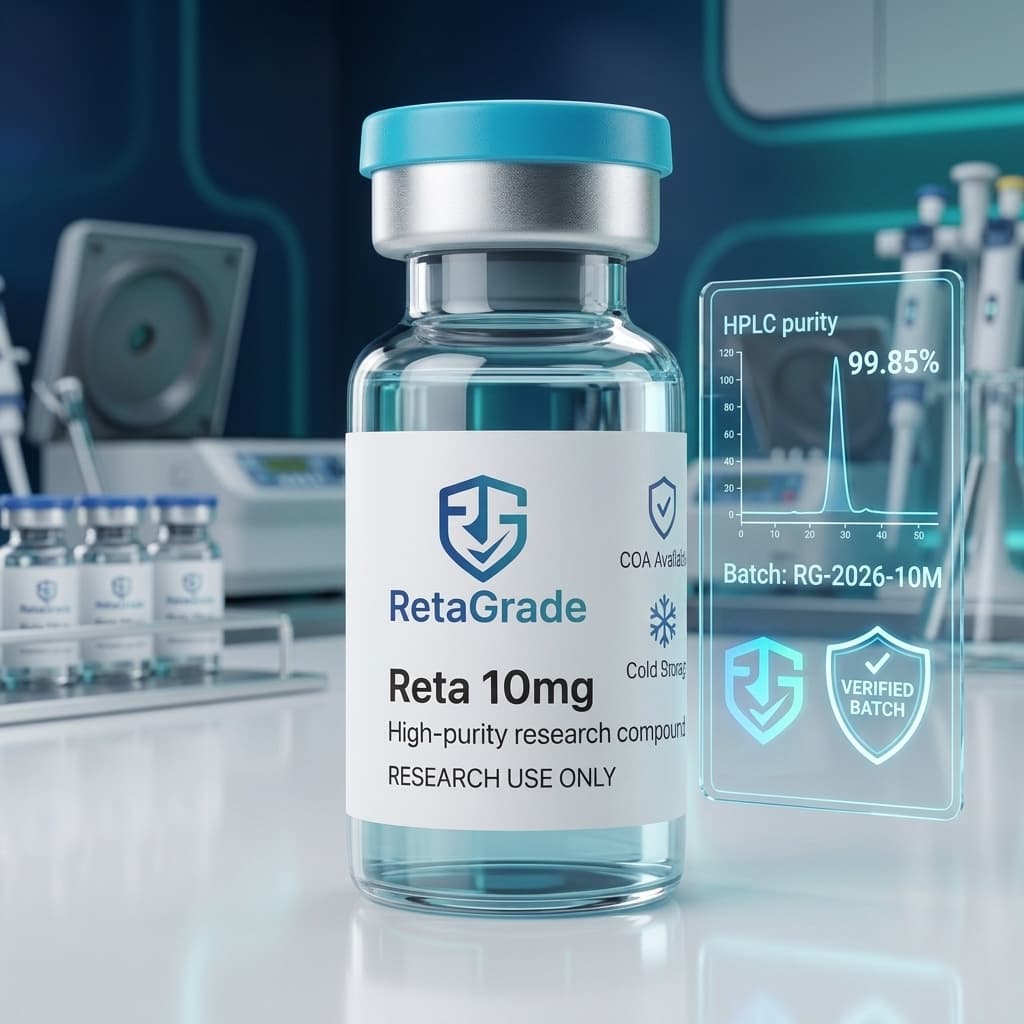
See whether the published certificate is released, superseded, or recalled.
Test summary
Review the reported identity, purity, and panel results attached to the record.
Clear boundaries
Missing records stay unverified, and demonstration data is labeled clearly.
Documentation guide
How to read a peptide Certificate of Analysis
A Certificate of Analysis is a laboratory’s signed record of what was measured on one specific lot. It is not a general claim about a product line. Two vials carrying the same nominal strength can come from different lots, and each lot carries its own certificate — which is why the lookup above is keyed to a lot or COA number rather than to a product name. The first check is always that the identifier on the certificate matches the identifier printed on the vial in front of you. If those two disagree, the certificate does not describe your material, however good its results look.
Each panel below answers a different question, and none of them substitutes for another. A result reported without its method is not a result: the method, instrument, sample identifier, test date, and approving analyst are what make a number auditable, and they are the parts of an issued document that no summary screen can replace.
What each analytical panel means
Appearance
A visual description of the lyophilized cake or powder and of the vial and closure. It reads as the softest entry on the certificate and is frequently the most informative one: a collapsed, shrunken, discolored, or oily cake points to a temperature excursion or a seal failure somewhere between fill and delivery, and no assay run months earlier can tell you that happened.
Identity by mass spectrometry
Confirms the molecule present is the one the sequence predicts, by comparing an observed mass against the calculated theoretical mass. Identity answers a yes-or-no question about which molecule is in the vial. It says nothing about how much of the sample is that molecule, which is why identity and purity are always reported as separate results.
Purity by RP-HPLC
Reversed-phase high-performance liquid chromatography separates the main peptide from its related substances — truncated and deletion sequences, oxidation products, and residual synthesis by-products. Purity is the main peak's area as a percentage of total integrated peak area at a stated detection wavelength, commonly 214 nm where the peptide bond absorbs. Two purity figures only compare when the column, gradient, and wavelength behind them match.
Net peptide content
The mass in the vial is not all peptide. Counter-ions left from purification, typically acetate or trifluoroacetate, together with residual water, account for a measurable share of the weight. Peptide content answers how much of the powder is peptide, which is a different question from how pure that peptide is — a lot can report high purity and a materially lower peptide content at the same time.
Water content (Karl Fischer)
Residual moisture in the lyophilized solid, reported as a percentage by weight. It matters because water is what shortens the shelf life of a dry peptide, and an elevated figure is corroborating evidence when the appearance entry also reads poorly.
Bacterial endotoxin (LAL)
Endotoxin measured by limulus amebocyte lysate assay and reported in endotoxin units per milligram. It is a laboratory suitability measure for assays that are sensitive to endotoxin contamination. It is not a sterility statement, and it does not qualify material for any use in humans or animals.
What a record status tells you
Released
The record is current. The lot was released against the specification in force when the certificate was issued, and nothing has replaced or withdrawn it since.
Superseded
A newer record exists for the same lot — a re-test, an expanded panel, or a correction to the issued document. The superseding certificate controls. The earlier one is retained rather than overwritten so the history of the lot stays legible.
Recalled
RetaGrade has withdrawn the lot. Stop using the material, isolate it from working inventory, and follow the instructions in the corresponding safety notice.
No published match
The identifier does not correspond to any published record. On its own this proves nothing in either direction — it is not evidence of a counterfeit and it is not evidence of authenticity. Re-check every character, then send the code to support.
Every record published here exists to support laboratory work. Nothing on this page, on a certificate, or in a lookup result is guidance for preparing or administering material, and RetaGrade does not provide it.
What verification means
This tool checks whether a COA or lot number matches a published RetaGrade quality record. The source laboratory certificate remains the controlling document for methods, specifications, and results.